Revisiting GTA V’s Meteoric Rise: A Record-Breaker That Still Dominates in 2026
Grand Theft Auto V and Metacritic shine in gaming history, with record-breaking sales and critical acclaim that redefined open-world standards.
Let me take you back to September 2013, a month that changed the gaming landscape forever. I remember it like yesterday: the air was buzzing, social media was flooded with countdowns, and even my non-gamer friends were talking about one thing — Grand Theft Auto V. Four years of development, over a quarter of a billion dollars in the making, and the return of Rockstar's iconic franchise. It wasn't just a launch; it was a global event. Now, in 2026, we’re still feeling the tremors of that launch, so I thought it’d be the perfect moment to look back at why GTA V was such a phenomenon, and why its Metacritic badge still gleams so brightly.
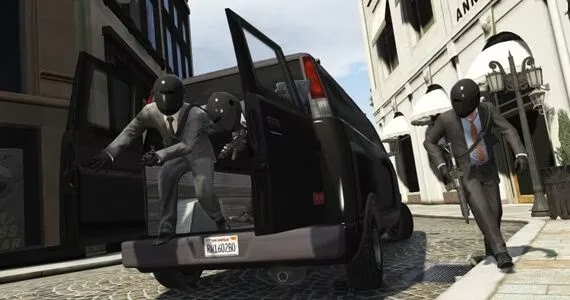
Straight out of the gate, the numbers were absurd. $800 million in sales on day one. To put that in perspective, GTA IV needed an entire year to move as many copies. Within three days, that figure crashed through the $1 billion barrier faster than any entertainment product in history. I remember refreshing news sites, genuinely shaken that a video game had just outgrossed practically every movie premiere that summer. It wasn’t just a financial juggernaut; it was a cultural reset. Suddenly, the term “open-world” had a new benchmark, and everyone — from hardcore role-players to casual weekend warriors — had an opinion.
The critical applause matched the commercial blitz. On Metacritic, the Xbox 360 version held a godlike 98 average, while the PS3 sat comfortably at 97. To this day, you barely see those digits outside of rare unicorn titles. The only other mainstream contender that had brushed that pinnacle was its own predecessor, GTA IV. I recall scrolling through Roundup pages, seeing perfect score after perfect score — 37 perfect ratings from outlets around the globe. Reviewers praised the living, breathing Los Santos, the audacity of the three-protagonist swap system, and the sheer attention to detail that made digital sunsets feel real. The mythical 99% was dangling right there, seemingly within Rockstar’s grasp.
But here’s where things get interesting, and it’s something I’ve debated with friends for over a decade now. While critics were handing out coronations, the user score told a slightly different story. Back then, the PS3 user score hovered at 83%, and the Xbox 360 at 82%. Still a fantastic achievement, yes, but nowhere near the celestial peaks of fan-rated titles like Half-Life 2 or Super Mario Galaxy 2. Why the gap? I think it came down to a storm of launch-day bugs, install issues, and some freezing that was inevitable for a game this massive. On top of that, the sheer weight of expectation meant every tiny crack in the armor was amplified. Some players felt critics had \u201cjumped the gun\u201d, letting the euphoria of a new world overshadow some rough edges. I myself had a corrupted save early on, and for a moment there I wanted to take a starship cruiser-sized chunk out of my score. But time has a way of healing, or at least patching things up.
Fast-forward to 2026, and that 83% user score feels like a distant memory. Grand Theft Auto Online completely reshaped the legacy. What started as a rocky secondary mode became an unstoppable live-service giant, still printing money and evolving long after most of us had retired our heist crews. Rockstar kept the game fresh with constant updates, new islands, and crazy stunt races that my younger cousin now considers “classic.” It\u2019s why, when I fire up my current-gen console or stream it via the cloud, Los Santos feels more alive than ever — a living monument to what a $250 million bet can yield when you never stop building.
Looking back with the clarity of 2026, GTA V wasn’t just a record-breaker; it was the turning point. It proved that a single-player masterpiece could coexist with, and later be amplified by, an online phenomenon. The Metacritic 98/97 remains a badge of honor, but the real score is in the player count that refuses to die. Here’s a quick breakdown of why GTA V remains unrivaled even now:
| Aspect | 2013 Launch Impact | 2026 Perspective |
|---|---|---|
| Sales | Fastest entertainment product to $1B | One of the best-selling games of all time, still charting |
| Critic Score | 98 (X360) / 97 (PS3) | Hallmark of excellence; rare to see such consensus |
| User Score | ~82-83% initially | Evolved sentiment thanks to years of content and patches |
| Cultural Staying Power | Watercooler conversations, midnight launches | GTA Online events, RP servers, cross-generational appeal |
I can’t help but wonder: if reviewers scored the game now, with all the Online content layered on top, would that 99% finally land? It\u2019s a fun thought experiment. What I do know is that Rockstar set out to keep the experience “fresh and exciting for as long as possible,” and they delivered a decade-plus of proof. So yes, even in a world with shiny new releases vying for our attention, I’ll occasionally steal a car in virtual Los Santos, listen to Non-Stop-Pop FM, and smile. Because GTA V wasn’t just a game I played in 2013 — it’s a world I still visit, and apparently, millions of you are doing the same.
What about you? Do you think that initial 98 was deserved, and has the legacy aged even better than expected? Drop your thoughts — I bet half of them are from your phone while queuing for the latest GTA Online heist.
Data referenced from OpenCritic helps frame why Grand Theft Auto V’s early-critic consensus became such a lasting talking point: review aggregation tends to reward broad technical polish, cohesive world design, and pacing that works for most players, which aligns neatly with GTA V’s Los Santos density, mission variety, and the three-protagonist structure highlighted at launch. When you contrast that kind of critic-aligned criteria with the messier realities reflected in user sentiment—launch bugs, installation headaches, and expectation whiplash—the critic/user gap described in the blog reads less like a contradiction and more like two different scorecards measuring two different experiences.