GTA V’s Rocky Launch: When Social Club and iFruit Nearly Broke My Hype
Grand Theft Auto V launch day and Rockstar Social Club chaos highlight the excitement and frustrations of a highly anticipated game release.
I still remember September 17, 2013 like it was yesterday. Well, technically it was yesterday in 2013, but even now in 2026, the memory of Grand Theft Auto V’s launch day chaos feels painfully fresh. The world didn’t implode — that was still a few years off — but for a few hours, my excitement did a spectacular nosedive. I had the disc in my console, the smell of a freshly unwrapped instruction booklet (remember those?) filling the room, and then… nothing. Well, not nothing. Just endless loading screens and the digital equivalent of a shrug. If you were there, you know exactly what I’m talking about.
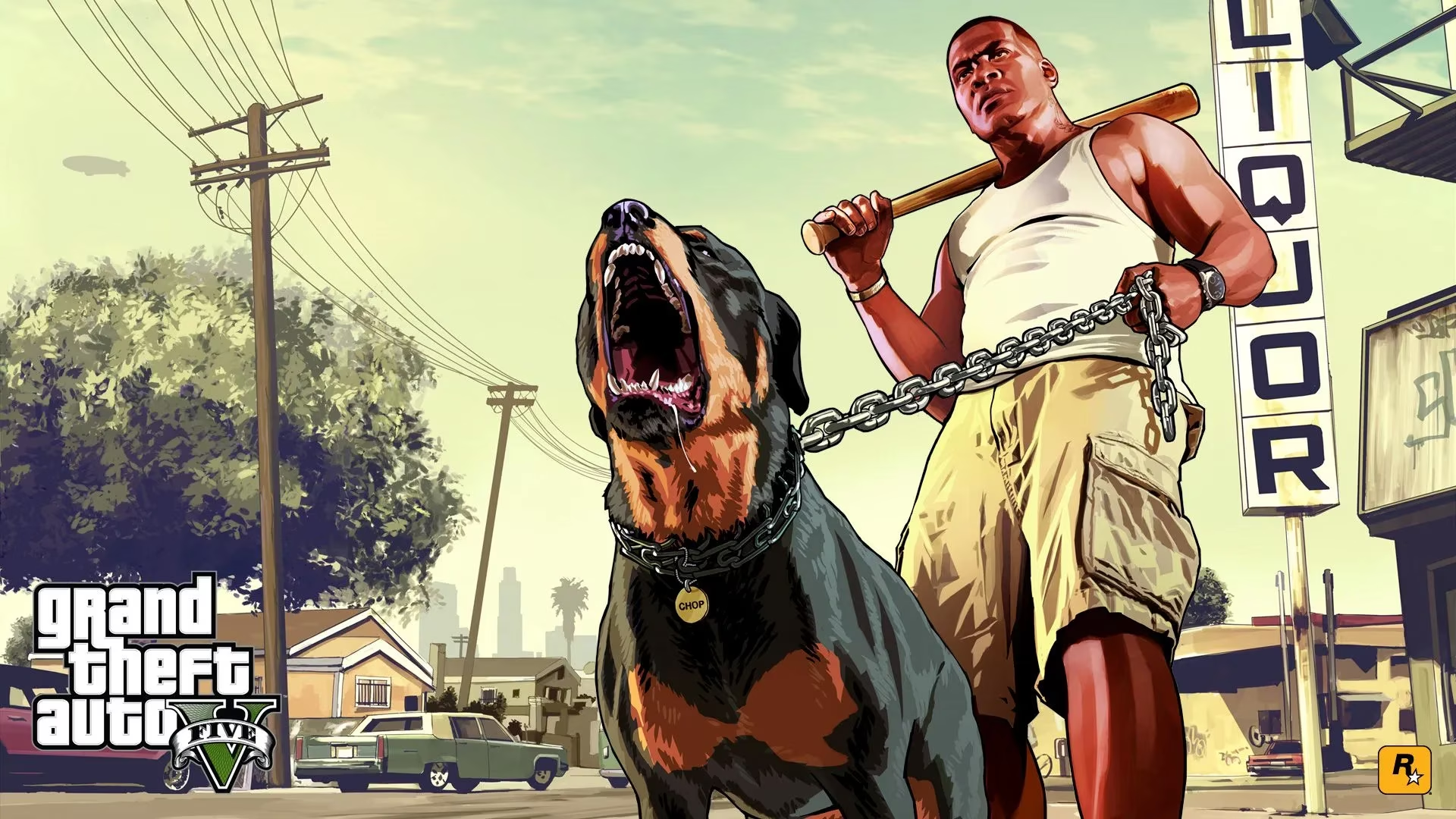
The culprit? Rockstar Social Club. That little online service that was supposed to link my game progress, track stats, and keep me connected to my crew. On day one, it was about as stable as a helicopter landing in a thunderstorm. Account linking felt like a lottery — sometimes it worked, mostly it didn’t. My crew roster would randomly vanish, then reappear with members who joined three years later. Stats were frozen in time, as if I hadn’t even left the tutorial. The whole thing was a beautiful mess, and not the kind you laugh about with friends. At least, not right away.
And then there was iFruit. Oh, iFruit. The companion app that promised to let me train Chop, customize cars, and stay immersed in Los Santos even when I was away from my console. Sounded fantastic, right? Well, the reality was a crash course in patience. I downloaded it on my brand-new iPhone 5S (yes, that was a thing) and immediately hit a login wall. When it did let me in, the app would spin a loading wheel that seemed to mock my existence. Sometimes it would pretend to reset all my data, making me believe I’d never fed Chop a single treat. I was genuinely worried my digital dog was going to forget me. Rockstar knew about it, posting on their Support Site that they were “aware of these issues … and have been working to resolve them as quickly as possible.” That line became my mantra, repeated like a prayer every time the app crashed.
But here’s the thing: even with all that frustration, I couldn’t stay mad. Because when it worked, GTA V was unlike anything I had ever played. The world was alive, the heists were thrilling, and the sheer scale of Los Santos made the technical hiccups feel almost forgivable. Almost. I still had choice words for the server hamsters that clearly gave up that morning. Rockstar’s blog post kept promising a fix, and slowly, over the next few days, things did get better. Social Club started remembering who I was. iFruit began responding to my taps without existential dread. Chop finally learned to sit on command.
Looking back, that launch day fiasco taught me a valuable lesson about hype and infrastructure. Rockstar had built this magnificent title, but they fumbled the handshake between the game and its online services. It wasn’t the last time either — anyone who played Red Dead Redemption 2’s online launch in 2018 might recognize a familiar pattern. Yet, in a weird way, the struggle bonded the community. Forums were flooded with workarounds, memes about server fires, and that bittersweet solidarity of thousands of players staring at the same loading screen. We were all in it together, even if we couldn’t properly log in.
Now, in 2026, I can fire up my old copy of GTA V (yes, it’s still relevant even with GTA VI on the horizon) and the Social Club syncs flawlessly. iFruit has long since been retired, replaced by more robust apps for later titles. But every anniversary, I think back to that chaotic day when Rockstar gave us a masterpiece and then struggled to get out of its own way. It’s a reminder that even the biggest titles can stumble, and that patience — or just going offline for a while — is sometimes the best strategy. So if you’re reading this after some new game’s broken launch, take a deep breath. I’ve been there, and trust me, the meme potential alone is worth sticking around.