GTA V's Enduring Reign in the UK: A Testament to Timeless Appeal
Grand Theft Auto V UK sales and GTA Online updates drive unmatched longevity, keeping the game atop charts in a digital era.
As I gaze upon the sales charts from across the pond, a familiar silhouette consistently crowns the peak. It is 2026, and the landscape of gaming has evolved with dazzling speed, yet here stands a titan from a bygone console generation, refusing to be dethroned. Grand Theft Auto V, a world I first stepped into over a decade ago, continues to weave its magic in the United Kingdom, not as a relic, but as a vibrant, living entity. How does a game, launched 174 weeks ago—a lifetime in the fast-paced digital arena—manage to outsell the flashiest new titles year after year? The answer, I find, is not in a single bullet point, but in a symphony of enduring design, community, and a touch of that Rockstar alchemy.
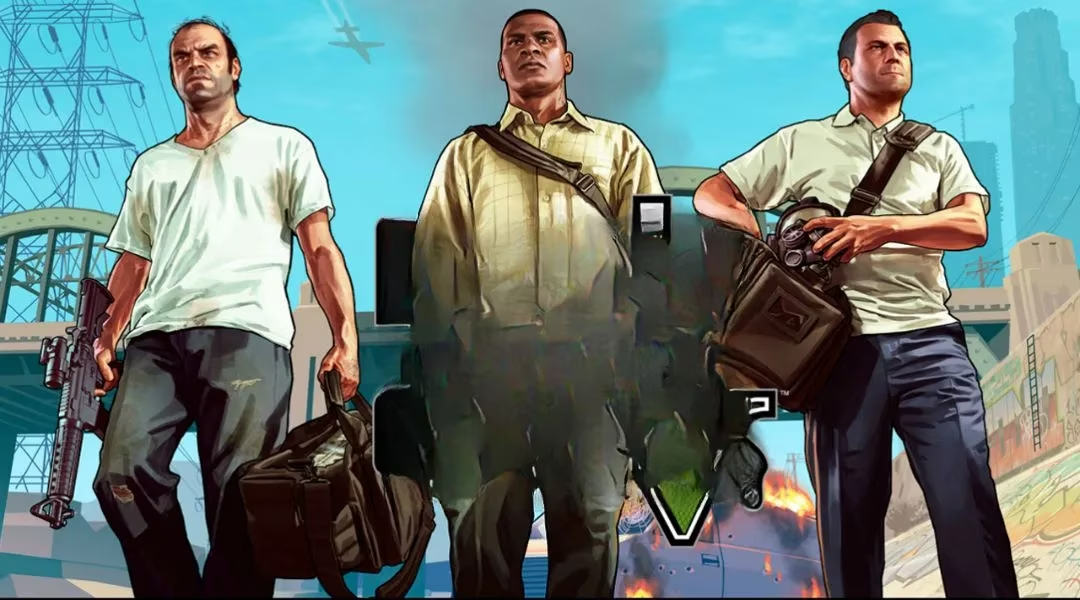
The Unshakeable Throne: Physical Sales in a Digital Age
Let us ponder this: the UK sales chart measures only physical, boxed copies sold in stores. In an era where my library exists in the cloud, and a new game is just a click away, this metric seems almost quaint. Yet, GTA V's dominance within this framework is nothing short of poetic. It recently clinched its tenth 'number one seller' title, a feat that feels like a quiet rebellion against the ephemeral nature of modern releases. Toppling giants like Call of Duty: Infinite Warfare, FIFA 17, and Battlefield 1—games that arrived with the full force of 2016's marketing engines—speaks to a deeper, more persistent pull. Is it nostalgia? Or is it something more substantial, a gravitational pull that draws new players into Los Santos year after year?
The Beating Heart: GTA Online's Perpetual Engine
If the single-player story is the game's soul, then GTA Online is its tirelessly beating heart. This, I believe, is the core of its longevity. Rockstar did not merely release a game; they planted a seed that has grown into a sprawling digital metropolis. Long after support ended for the PS3 and Xbox 360, the current-generation and PC versions have been nurtured with a regular, almost seasonal, stream of content.
Consider the lifecycle of an update:
-
Tease & Hype: A new DLC is announced—perhaps a heist, a business venture, or a fleet of absurdly fast cars.
-
Launch & Play: The community floods in, exploring every new corner, from the Import/Export warehouses to the depths of the latest underground racing league.
-
Sustain & Evolve: Microtransactions, while controversial, fuel this cycle, allowing Rockstar to fund these substantial updates without charging for them directly.
This cycle is a masterclass in live-service engagement. Each update is not just content; it's a marketing event. It reignites conversations, pulls lapsed players back in, and gives newcomers a compelling reason to join the fray. Why buy a game from 2013? Because the party is still going, and the guest list keeps growing.
The Lingering Echo: The Ghost of Story DLC
Yet, amidst the booming economy of GTA Online, a whisper of what could have been still echoes through the community. Many of us, myself included, often wonder: what if? What if Rockstar had channeled some of that creative energy into single-player narrative expansions for Michael, Franklin, and Trevor? The potential was—and in many hearts, still is—immense. Some argue that such story DLC would have driven sales and revenue to even greater heights, capturing an audience that yearns for deeper narrative immersion beyond the chaotic sandbox.
Alas, the rumored map expansion and story missions seem to have been forever lost to the priorities of GTA Online. But in this constant demand, I see a testament to the strength of the original creation. The fact that players still clamor for more story, years later, is a rare and beautiful form of praise. It is a silent plea from a dedicated player base, a reminder that the roots of this tree are as important as its ever-expanding branches. Perhaps, if the chorus grows loud enough... but for now, we live in the world Rockstar sustains.
A Cultural Phenomenon, Not Just a Game
So, as I reflect on GTA V's journey to 2026, its six million copies sold in the UK alone represent more than a commercial statistic. They represent a shared cultural touchstone. It is a game that parents who played it at launch now see their teenagers discovering. It is a world that serves as a digital playground, a social space, a racing simulator, and a cinematic experience all at once.
The table below contrasts its enduring appeal with the typical lifecycle of a blockbuster title:
| Feature | Typical Blockbuster (e.g., 2016 Release) | GTA V (2026 Perspective) |
|---|---|---|
| Sales Peak | Launch month & holiday season | Consistent, recurring chart-topping spikes |
| Post-Launch Content | Maybe 1-2 DLC packs, then sequel focus | A continuous, multi-year stream of free Online updates |
| Community Activity | Declines sharply after 6-12 months | Sustained, vibrant, and multi-generational |
| Retail Shelf Life | 1-2 years as a prominent title | Over a decade of consistent physical sales |
In the end, GTA V's story in the UK is one of defiance. It defies obsolescence. It defies the notion that a game must be new to be relevant. It is a lesson in building a world so rich, so detailed, and so full of possibility that it becomes a place to return to, not just a product to finish. As the sun sets over Vespucci Beach for the millionth time, I realize Rockstar didn't just sell us a game. They sold us a second home, and in the UK, it seems, that home has a permanent lease. 🏙️🎮