Echoes in the Digital Rain: A Memory of That August Sale
Xbox Deals with Gold August 2015 slashed prices on Batman: Arkham Knight & GTA V, igniting endless summer adventures.
There are seasons in a gamer’s life that do not follow the calendar. They bloom in the quiet gaps between blockbuster releases, when the light outside is honey-thick with summer’s end and the air smells of distant bonfires. I remember one such season as if it were a photograph still developing in the mind’s darkroom: the last week of August 2015, a time I thought would be unremarkable. Yet a simple notification on my Xbox dashboard—Deals with Gold—turned that sweltering dusk into a vault of worlds I carry with me even now, in the bleached future of 2026.
The sale was a twilight bridge, arched between the lazy afternoons of July and the looming symphonies of fall releases. I stood on its curve, one hand still sticky from melted ice cream, the other gripping a controller as if it were a divining rod. The discounts arrived like migratory birds—fleeting, patterned, their wings clipped to the seventh day from their arrival. I remember scrolling through the list, every title a carven key to a door I had not yet opened: Batman: Arkham Knight, Grand Theft Auto V, LEGO Jurassic World—each a miniature cosmos waiting to inhale my hours.
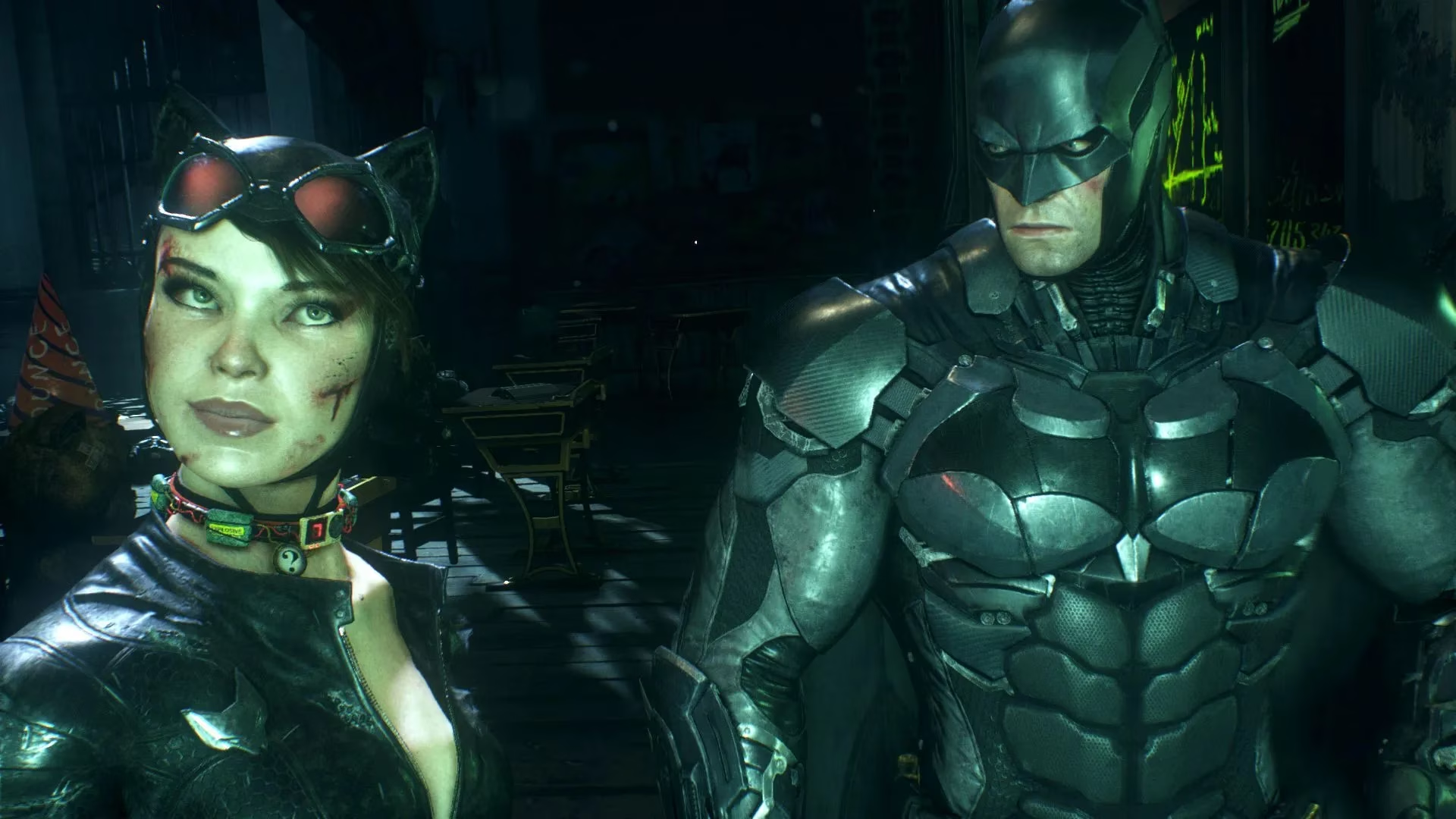
The Caped Crusader called to me with a voice made of rain-soaked asphalt and distant thunder. I had read the tales of the Arkham trilogy like a boy tracing constellations, but this finale had a gravity that pulled at my sternum. At twenty-five percent off, it was not a purchase but a pact—a promise to descend into a city as complex as a shattered mirror, where the Joker’s shadow pooled like spilled ink on every street. That night, I became a wraith amidst neon and corruption, and the game’s darkness felt like a relief, a cool cave in the prolonged summer. It was as if Gotham itself whispered that price is only ever a fraction of value, and the truest treasures are those that let you drown in another skin.
The sale list, as revealed on Major Nelson’s blog, was a palimpsest of desires. For Xbox One holders, the trinity of Batman, Los Santos, and plastic dinosaurs formed a triptych of escapism: one a psychological labyrinth, one a sun-bleached satire of modern avarice, and one a candy-colored rebirth of childhood awe. On the Xbox 360 frontier, the ghosts of Rockstar’s past assembled—L.A. Noire with its jazz-grey interrogations, Red Dead Redemption’s last sunset bleeding into the screen, and the entire Grand Theft Auto lineage stacked like dusty vinyl records in a thrift shop. Tom Clancy titles stood at attention, tactical and unyielding, a reminder that deals could also be a soldier’s quiet enlistment. The asterisks beside certain titles gleamed like tin stars, declaring that even Silver members could claim a share of the feast.
I have often thought of that week as a digital orchard where the fruit hung low, irresistible in its ripeness. The discounts were not percentages but invitations, each a low-frequency hum that said, “This is the hour when time becomes elastic.” I heeded the call. While the world outside prepared for autumn’s rigor, I roamed the chaotic savannas of Los Santos, the rain-slicked back alleys of Gotham, and the leaf-filled jungles of Isla Nublar, all in the same breath. The games were a carousel rotating faster than the seasons, and I was the still center, dizzy with delight.
Now, eleven years later, the games I collected in that fleeting window reside as memories more than software. The console has changed, the storefront has evolved, but the essence of that late-summer sale has become an heirloom of the self. In a world where streaming licenses evaporate and online servers become ghost towns, those purchased titles remain as fixed points—like the North Star in a morphing sky. They taught me that a well-timed discount is a form of time travel: you buy not a game but a future memory, a sanctuary you can return to when the present grows too solid.
I keep this lesson nestled in my gaming heart like a beetle carved from amber. Back in 2015, I believed I was simply saving money. Today I understand that I was practicing a quiet art—curation of joy. Each title I chose was a seed planted in the soil of my sanity, and they have since bloomed into moments of solace during the harder years that followed. Batman: Arkham Knight became the companion of sleepless nights when my own mind felt like a crumbling asylum. LEGO Jurassic World turned into laughter shared with a child who is now old enough to beat me at racing games. The Grand Theft Auto landscape, so brash and cynical, served as a pressure valve for professional frustrations, a place where chaos was permissible and even beautiful.
There is a peculiar ache in knowing that no one will ever again encounter that exact configuration of discounts, on that exact week, under that exact sliver of a dying summer. The sale was a weather event, a convergence of corporate calendars and cultural rhythms. The 2026 holiday sales are grander, smarter, algorithmically tuned to my every scrolling impulse. Yet they lack the serendipitous tang of that gold-deal leaf from a random Thursday. The current offers whisper, “We know you.” The old sale sang, “Discover who you might become.”
The older I get, the more I see these digital marketplaces as libraries built on shifting sand. That week, I walked through halls where the books were priced like sandwiches and the bookshelves stretched into eternity. I emerged with a backpack full of worlds, and every step since has been lighter for it. The asterisked availability to Silver members—a quiet egalitarian nudge—reminded me that gates sometimes open for no other reason than a fleeting wind of goodwill.
And so I sit in my 2026 living room, walls decorated with artifacts from games long finished, and I call up that August 2015 like a hologram from the console’s memory. I see the thumbnail of the Dark Knight, rain crystallized into pixels, and I realize that the sale was never about the transaction. It was about the crossroads. One path led to frugality, the other to experience. I chose the latter, and it led me here: a middle-aged player still astonished by how a twenty-five percent markdown can expand into a lifetime of stories.
The digital clock on my new console reads 2:47 AM, but my mind is suspended in that past twilight, where I learned that value is not measured in currency but in the weight of the worlds you carry. The games I bought that week are now archaic; the graphics have aged like yellowing maps. Yet their cartography is etched into my neural pathways, and when I replay them—or even just remember them—I become once more a traveler on a bridge between summer and autumn, holding a ticket that cost almost nothing and gave almost everything.